
This post was originally published on this site.
Collective Mining (TSX, Nasdaq: CNL) has extended its Apollo system in Colombia 100 metres north after two drill holes targeting the deeper Ramp zone unexpectedly cut a new mineralized breccia body, including 38 metres grading 15.25 grams gold per tonne.
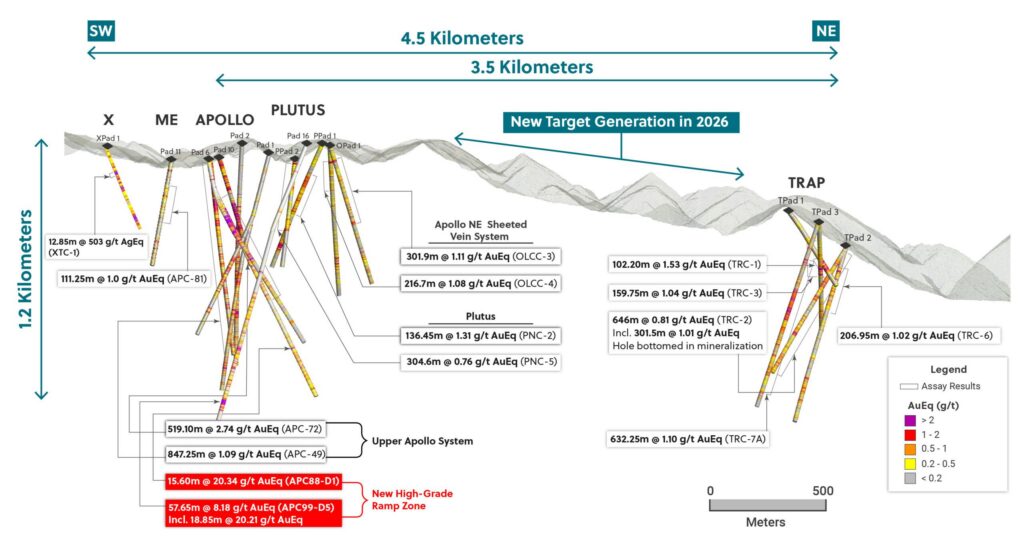
Drill hole APC172-D2 cut 141.4 metres grading 4.75 grams gold, 5 grams silver, 0.02% copper and 0.04% zinc from about 924 metres below surface, the company said Tuesday. The interval included 38 metres at 15.25 grams gold, 8 grams silver, 0.03% copper and 0.06% zinc. The intervals grade 4.88 and 15.46 grams gold-equivalent, respectively. See a 3-D image.
“APC172-D2 delivered an exceptional high-grade interval at approximately 1,000 meters below surface while significantly extending the system both northward and vertically,” Executive Chairman Ari Sussman said in a release. “With mineralization in this new northern breccia body expansion open in multiple directions and follow-up drilling already intersecting visually prospective material to the west, we see strong potential to continue expanding this part of Apollo.”
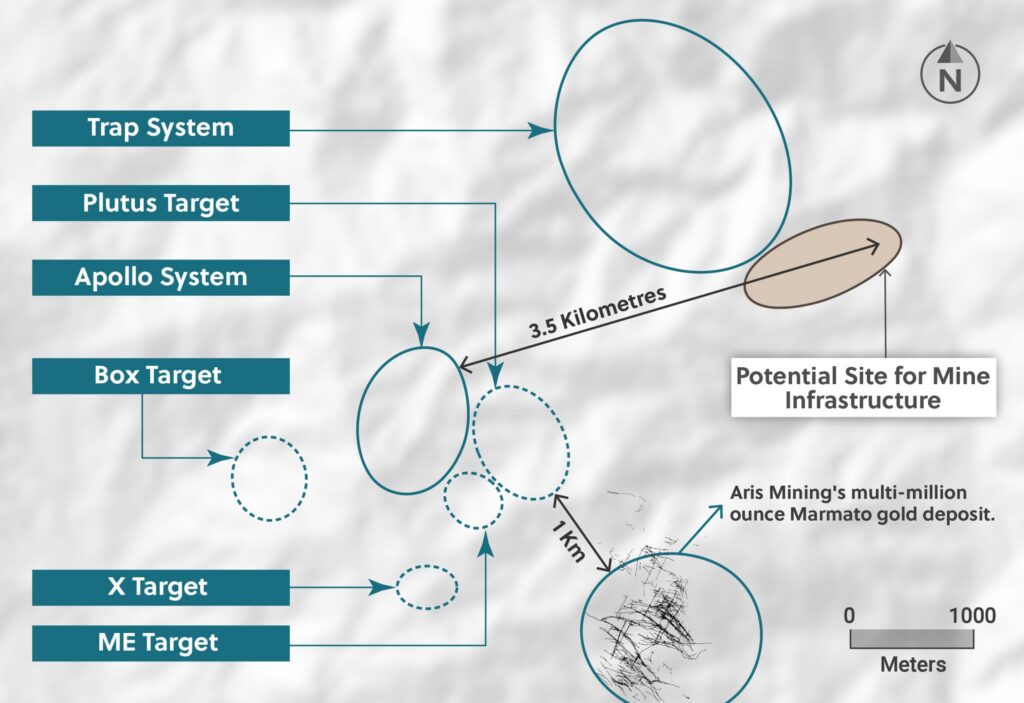
Apollo anchors Collective’s large-scale Guayabales project in the Middle Cauca mineral belt and historic Marmato-Supía gold district of Caldas, where gold and silver mining dates back more than 500 years. Ten permitted mines operate within about 3 km of Guayabales, which lies next to Aris Mining’s (TSX: ARIS; NYSE-A: ARMN) Marmato gold mine. Apollo itself is a recent discovery, first drilled in 2022, and Collective expects to issue its initial resource this month.
Shares in Collective Mining gained 3% to $21.41 apiece by mid-Tuesday in Toronto, valuing the company at $1.99 billion. They’ve risen by more than 14% over the past 12 months.
Accidental discovery
The two directional drill holes, APC172-D1 and APC172-D2, were collared southwards to test the Ramp zone at depth when they encountered the new mineralization before reaching their intended target.
The breccia lies about 100 metres north of Apollo’s previously known limit between elevations of 910 and 1,040 metres above sea level. The drill holes also extended mineralization about 170 metres vertically below previous drilling on Apollo’s northern side. Assays from their intended Ramp zone targets remain pending.
Drill hole APC172-D1 cut 97.15 metres grading 0.95 gram gold, 4 grams silver, 0.02% copper and 0.02% zinc from about 929 metres below surface, equivalent to 1.06 grams gold-equivalent.
National Bank Financial analyst Don DeMarco said the results reinforce the potential to grow the upcoming resource. The elevated grades and their location near a planned underground access tunnel could also improve potential project economics, while the broad mineralized intervals support bulk-mining methods, he said.
The new northern breccia body is encouraging because of its sizeable step-out distance, strong grades and mineralization remaining open in several directions, DeMarco said. National Bank rates Collective outperform with a C$32 target.
Scotiabank analyst Ovais Habib also called the results positive, saying the new northern extension highlights a high-grade mineralized zone while infill drilling elsewhere at Apollo confirmed expected grades in Collective’s internal model. Scotiabank rates the shares sector outperform with a $35 target.
Room to grow
The northern extension remains open east, west and at depth. Follow-up drill hole APC180-D1 has already intersected as much as 100 metres of visually prospective mineralization about 100 metres west of APC172-D2, with assays pending. Another drill hole is testing below the two discovery intercepts.
The results add another growth area to Apollo after Collective spent much of this year expanding the high-grade Ramp zone. In May, initial drilling on Ramp’s western side returned 23.1 metres grading 4.61 grams gold and 11 grams silver, while another drill hole included 5.3 metres at 37.04 grams gold and 28 grams silver.
Earlier in the year, step-out drilling at Apollo returned 165.75 metres grading 4.39 grams gold, 42 grams silver, 0.13% copper and 0.09% tungsten trioxide from just 8.85 metres depth. National Bank said at the time that grades were coming in as much as 40% above Collective’s model.
Seven infill drill holes in the latest program also tested gaps in lower-grade portions of Apollo’s internal block model. Drill hole APC160-D3 returned 171.65 metres grading 1.77 grams gold, 15 grams silver, 0.05% copper and 0.09% zinc from 575 metres below surface, including 44.9 metres at 4.66 grams gold, 13 grams silver, 0.02% copper and 0.17% zinc.
Drill hole APC160-D4 cut 83 metres grading 1.66 grams gold, 16 grams silver, 0.04% copper and 0.21% zinc from 528 metres below surface, including 15.3 metres at 3.64 grams gold, 28 grams silver, 0.07% copper and 0.44% zinc.
Collective has received assays for about 188,000 metres of drilling across Guayabales and its nearby San Antonio project, including 124,000 metres at Apollo. Thirteen drill rigs are operating at Guayabales as part of a program of up to 90,000 metres this year.
The company has accelerated exploration since Agnico Eagle Mines (TSX, NYSE: AEM) invested $63.4 million in late 2025. Collective also shifted its executive headquarters from Toronto to Miamiin March to move closer to its Colombian operations and U.S. capital markets.


